Overview
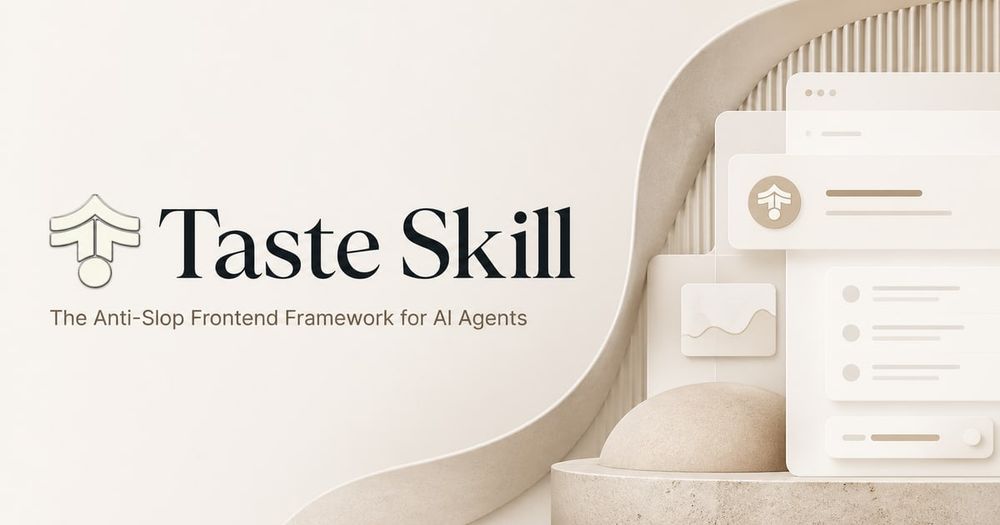
Taste Skill is an open-source frontend framework designed to combat "slop" in AI-generated code, enabling AI agents to produce unique and high-quality user interfaces. It focuses on providing "anti-slop" skill files that guide AI tools like Cursor, Claude Code, Codex, Gemini CLI, v0, and Lovable to generate less generic and more polished frontends.
Key Features
- Anti-Slop Framework: Prevents AI agents from generating templated or low-quality frontend code.
- Broad Agent Compatibility: Works with a wide range of AI coding agents that support SKILL.md files, including Cursor, Claude Code, Codex, Gemini CLI, v0, Lovable, and more.
- Specialized Skills: Offers various skills tailored for different design needs, such as
taste-skill(v2 experimental) for inferring design direction,gpt-tasteskillfor stricter GPT/Codex output,image-to-code-skillfor design-first implementation,redesign-skillfor audits, and visual style skills likesoft-skillandminimalist-skill. - v2 (Experimental) Release: Features a significant rewrite with improved brief inference, design system mapping, dark mode protocol, redesign protocols, and a strict pre-flight check.
- Open Source & Community Driven: Developed as an open-source project with community contributions and sponsorship.
Use Cases
- AI-Assisted Frontend Development: Enhance the output quality of AI coding agents for faster and more sophisticated UI development.
- Design System Implementation: Ensure AI-generated interfaces adhere to specific design systems or create new ones.
- Code Auditing and Refinement: Use skills like
redesign-skillto audit and improve existing AI-generated codebases. - Rapid Prototyping: Quickly generate unique frontend prototypes with AI assistance.
Supported Agents
Taste Skill is compatible with:
- Codex
- Claude Code
- Cursor
- OpenCode
- Gemini CLI
- AI Studio
- v0
- Lovable
FAQ
What is "slop" in the context of frontend development?
"Slop" refers to generic, uninspired, or low-quality code and design that AI agents often produce by default, lacking uniqueness and polish.
How does Taste Skill prevent generic outputs?
It provides specialized "skill files" that act as instructions or constraints for AI agents, guiding them to adhere to specific design principles, audit processes, and stylistic requirements, thus avoiding templated results.
Can I use Taste Skill with my existing AI coding tools?
Yes, if your AI tool supports SKILL.md files or a similar mechanism for custom instructions, Taste Skill can be integrated. It explicitly lists compatibility with popular agents like Cursor, Claude Code, and Gemini CLI.
What's new in v2 of Taste Skill?
Version 2 is an experimental rewrite focusing on better brief inference, mapping briefs to design systems, improved dark mode handling, stricter redesign protocols, and a more robust pre-flight check for generated code.
How do I install Taste Skill?
You can install it using npm with the command: $npx skills add Leonxlnx/taste-skill. For specific versions or skills, additional flags or paths might be used, such as --skill "design-taste-frontend" for v2.
How can I support the development of Taste Skill?
You can support Taste Skill by sponsoring the project on GitHub.